
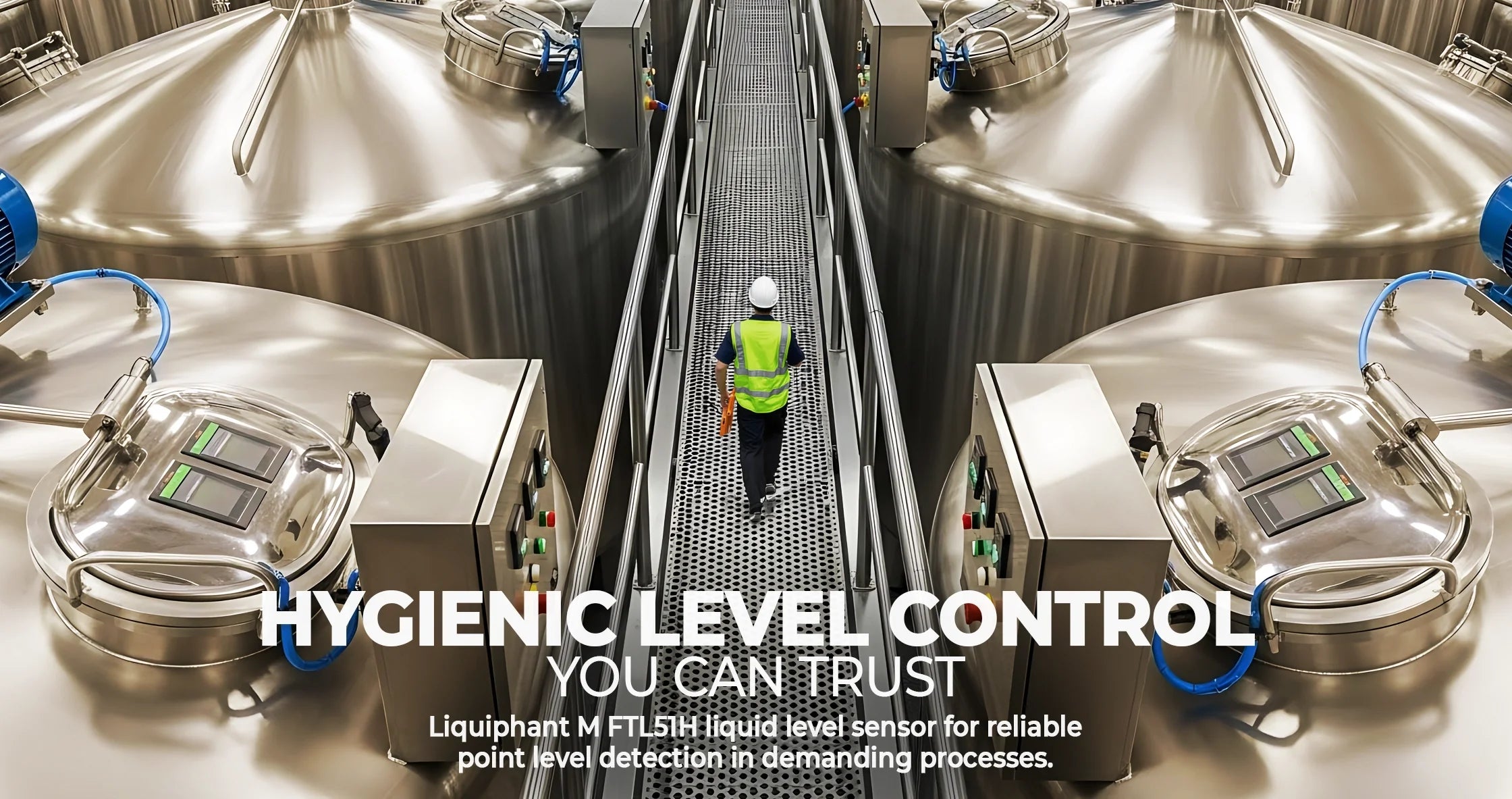
In many hygienic and industrial plants, engineers need point level devices that “just work” regardless of foaming, changing density, or turbulence in the tank. The Liquiphant M FTL51H liquid level sensor from Endress+Hauser is designed exactly for that kind of reliability. It’s a compact vibronic level switch with a hygienic design, 316L stainless-steel wetted parts, and a robust housing that can handle demanding food, beverage, pharmaceutical, and chemical processes.
Unlike float switches or capacitive probes, the Liquiphant M FTL51H liquid level sensor uses a vibrating fork to detect the presence or absence of liquid. When the fork is free, it vibrates at a defined frequency; when covered by liquid, that frequency drops and the electronics convert the change into a sharp, reliable switching signal. Because it responds primarily to the difference between air and liquid, it is largely unaffected by viscosity, density variation, bubbles, or light buildup on the fork.
The “H” in Liquiphant M FTL51H liquid level sensor stands for its hygienic variant. This model is equipped with polished 316L wetted parts and Tri-Clamp connections so it can be installed confidently in sanitary tanks, process skids, and lines that must comply with strict food and pharma hygiene requirements. For users in dairy, brewery, or biotech facilities, that means one instrument can cover both cleanliness expectations and tough process conditions.
How the Liquiphant M FTL51H liquid level sensor works
At the heart of the Liquiphant M FTL51H liquid level sensor is the vibronic measuring principle. A two-pronged fork is driven at its natural resonant frequency when it is in air. As soon as the fork is immersed in a liquid, the additional mass and damping reduce the frequency. The internal electronics continuously monitor this change and flip the output state when the fork is covered or uncovered.
Because the Liquiphant M FTL51H liquid level sensor detects a frequency shift rather than capacitance or buoyancy, it doesn’t need product-specific calibration. Anything with a density above the configured threshold is recognized as “liquid,” while foam or vapour is ignored. Standard settings detect media with densities around 0.7 g/cm³ and, with a sensitivity switch, that threshold can be lowered further for lighter liquids.
The same vibrating fork technology also enables density measurement when the Liquiphant M FTL51H liquid level sensor is paired with the FML621 density computer and the appropriate FEL50D electronics insert. In this configuration, the instrument sends a frequency or pulse signal proportional to the liquid’s density instead of simple on/off switching. The density computer then converts this into useful concentration units such as °Brix, °Baumé, or standardized density at reference temperature.
Key technical specifications that matter in real plants
When specifying the Liquiphant M FTL51H liquid level sensor, engineers are not just interested in the measuring principle; they also care about whether it can survive the process. This model is built to work in process temperatures from about –50 °C up to +150 °C in contact with the product, with full accuracy guaranteed in the 0…+80 °C range. That means it can withstand both chilled media and hot SIP (steam-in-place) cycles that are typical in hygienic environments.
Pressure capability is another strength of the Liquiphant M FTL51H liquid level sensor. The device supports vacuum up to 25 bar as standard, and can handle up to 64 bar with certain versions, with the fork design tested to even higher burst pressures for safety margins. This covers most storage tanks, mixing vessels, and hygienic reactors, while maintaining long-term mechanical integrity even in agitated or pressurized systems.
Wetted materials on the Liquiphant M FTL51H liquid level sensor are electropolished 316L stainless steel, giving a very smooth surface roughness in line with hygienic guidelines. The fully welded fork and extension design minimize crevices where product could accumulate, supporting cleanability and reducing contamination risk. For plants that handle aggressive chemicals, a related FTL51C variant is available with coatings on the fork, but many food-grade or pharmaceutical liquids are fully compatible with standard 316L.
Hygienic design of the Liquiphant M FTL51H liquid level sensor
The Liquiphant M FTL51H liquid level sensor is engineered specifically for hygienic use, making it an excellent fit for applications where cleaning, sterilization, and product quality are non-negotiable. Its Tri-Clamp connection (for example a 2-inch Tri-Clamp coded as TE2 in the order string) provides a proven sanitary interface. When paired with the correct gasket materials such as EPDM, FKM, or PTFE-encapsulated seals, it forms a crevice-free joint that withstands CIP and SIP procedures.
Surface finish is critical for hygiene, and the Liquiphant M FTL51H liquid level sensor uses polished 316L surfaces that meet leading hygienic design expectations for cleanability. Gentle profiles, minimal dead legs, and weld-free wetted assemblies help avoid product deposits. This is especially important in dairy or biotech plants, where any microscopic roughness or pocket can harbour biofilm and compromise sterility.
Third-party approvals underline the hygienic suitability of the Liquiphant M FTL51H liquid level sensor. It complies with 3-A Sanitary Standards for hygienic equipment, meets EHEDG criteria for clean-in-place performance, and follows ASME BPE guidance for bioprocessing equipment. The materials in contact with the medium are FDA-compliant and supported by documentation such as material certificates and surface roughness certificates, which simplifies validation work in regulated environments.
Safety, SIL integrity, and certifications
For many users, the strongest reason to choose the Liquiphant M FTL51H liquid level sensor is safety. The device is certified for functional safety to IEC 61508/61511, achieving SIL 2 with a single instrument and SIL 3 in redundant architectures. This makes it suitable as a safety instrumented function component for high-level or low-level protection in storage tanks, reactors, and process vessels.
The Liquiphant M FTL51H liquid level sensor is also extensively approved for hazardous areas. It carries common global explosion protection approvals, enabling installation in explosive gas and dust atmospheres, including Zone 0/1 and Class I, Div. 1 locations depending on the variant. This flexibility means one family of instruments can cover both hygienic and hazardous applications, from solvent tanks in pharma plants to alcohol-based processes in beverage production.
Beyond explosion protection and SIL, the Liquiphant M FTL51H liquid level sensor complies with environmental and mechanical standards such as requirements for overfill prevention of water-polluting liquids, CE marking for EMC and low-voltage directives, RoHS substance restrictions, and relevant pressure boundary regulations. Marine approvals from classification societies also qualify the device for use on ships and offshore platforms, where ruggedness and safety are vital.
Installation and mounting best practices
One advantage of the Liquiphant M FTL51H liquid level sensor is its mechanical flexibility. It can be mounted vertically from the top of the tank, horizontally from the side, or even from the bottom depending on whether it serves as a high- or low-level switch. For a typical vertical installation, the switching point in water is around 13 mm above the fork tip, giving a repeatable reference for designers who need to meet strict level alarm heights.
When installing the Liquiphant M FTL51H liquid level sensor horizontally, it is best to rotate the fork so the tines are vertical, one above the other. This orientation allows gas bubbles and solids to fall away instead of being trapped between the tines, reducing buildup and maintaining sensitivity. It also minimizes the area where viscous media can settle, which is important in applications with syrups, creams, or thick slurries.
Clearance from vessel walls and internals is essential. The Liquiphant M FTL51H liquid level sensor should be placed a few inches away from walls or agitators to avoid contact with buildup or mechanical interference. In piping, the minimum diameter should be around 2 inches so the fork can sit fully within the flow without touching the pipe wall. For installations in long nozzles, care should be taken to deburr openings and ensure that CIP fluids reach all around the fork for thorough cleaning.
Extension tubes and flush-mount options on the Liquiphant M FTL51H liquid level sensor
A distinctive feature of the Liquiphant M FTL51H liquid level sensor is its extension tube, which allows the sensing point to be positioned deep inside a vessel while the process connection remains at the mounting flange or nozzle. Standard lengths range from roughly 115 mm up to 3 m, and custom lengths up to about 6 m are possible for special tanks. This lets designers place the switch exactly where required for pump protection, overfill prevention, or interface detection.
Even at longer lengths, the Liquiphant M FTL51H liquid level sensor is engineered for mechanical stability, with an extension able to handle significant lateral forces and bending moments. For very long probes, or where agitators generate strong turbulence, it can be supported with a bracket or guide tube to prevent excessive vibration. The extension design is well suited for stilling wells or bypass chambers where level or density needs to be monitored in a quieter side leg rather than the main tank.
For processes that cannot tolerate intrusive elements in the flow path, the Liquiphant M FTL51H liquid level sensor can be installed using flush-mount adapters. These welded sleeves let the fork sit in a recess essentially flush with the wall of a pipe or vessel. This approach is attractive where scrapers are used to clean fermenters or where any protrusion would create product hang-up, while still providing reliable point level detection at the desired height.
Electronics, outputs, and commissioning the Liquiphant M FTL51H liquid level sensor
The Liquiphant M FTL51H liquid level sensor offers modular electronics so plants can match the output type to their control philosophy. Depending on the chosen insert, the device can provide two-wire AC or DC switching, three-wire PNP transistor output, NAMUR low-power signalling, relay outputs, or a pulse/frequency (PFM) signal for density measurement. The DC4 configuration associated with FEL50D, for example, is intended for use with transmitters like the FML621 or Nivotester units.
Powering and wiring the Liquiphant M FTL51H liquid level sensor is straightforward. PFM/NAMUR versions are supplied from a transmitter power unit at about 8.2 V DC, while relay or transistor versions operate over standard industrial ranges such as 10–35 V DC or 24–253 V AC/DC depending on the module. Internal terminals are clearly marked, and the housing offers either cable glands or connectors, with ingress protection up to IP66/68 and even IP69K in stainless-steel compact housings for high-pressure wash-down zones.
Commissioning requires minimal effort because the Liquiphant M FTL51H liquid level sensor does not need liquid-specific calibration. After installation and wiring, the engineer simply sets the fail-safe mode—MAX for overfill or MIN for dry-run protection—using a selector on the electronics. Sensitivity can then be chosen according to liquid density requirements. A functional test is easily carried out either by filling the vessel to cover the fork or by using the built-in magnetic test point on the housing to simulate a covered state.
Diagnostic features and accessories for the Liquiphant M FTL51H liquid level sensor
The Liquiphant M FTL51H liquid level sensor includes self-monitoring diagnostics that continuously check fork vibration and electronic health. If corrosion, damage, or an internal fault drives the resonance outside the expected range, the instrument forces its output to a defined alarm state and indicates the condition with a status LED. This behaviour aligns with SIL requirements and simplifies fault detection in safety systems.
For integration, Endress+Hauser offers several accessories to work with the Liquiphant M FTL51H liquid level sensor. Nivotester switch amplifiers provide power, intrinsic safety barriers, and relay outputs for NAMUR or PFM versions, allowing direct interface to pumps, alarms, or PLCs. The FML621 density computer, when paired with the FEL50D electronics, turns the level switch into a continuous density or concentration measurement device, complete with 4–20 mA and HART outputs for modern control systems.
Additional options further extend the usefulness of the Liquiphant M FTL51H liquid level sensor. Weld-in sleeves and flush adapters optimize hygienic mounting, while weather shields and stainless housings protect against UV and aggressive wash-down regimes. Swappable electronics inserts allow instrument technicians to change from relay to PNP or fieldbus options if the control strategy evolves, and newer Liquiphant family members even include advanced diagnostics and mobile configuration for plant-wide standardization.
Typical applications for the Liquiphant M FTL51H liquid level sensor
In the food and beverage sector, the Liquiphant M FTL51H liquid level sensor performs reliably in dairy tanks, CIP solution vessels, brewing kettles, and fermentation tanks. Its resistance to foam and bubbles makes it ideal for managing high-level alarms during vigorous fermentation, while its hygienic approvals assure quality teams that cleaning cycles will reach every wetted surface. Brewers can also leverage the density function to track wort and beer density, helping them monitor fermentation progress without adding extra instrumentation.
The Liquiphant M FTL51H liquid level sensor is equally at home in pharmaceutical and biotech facilities. Bioreactors, buffer preparation tanks, chromatography skids, and WFI storage tanks all benefit from a compact, polished instrument that doesn’t compromise sterility. The sensor can guard against overfill that could jeopardize expensive batches, protect pumps from dry running in critical transfer lines, and meet the documentation needs of cGMP environments with material and surface certificates.
Chemical plants also make good use of the Liquiphant M FTL51H liquid level sensor where media are compatible with 316L. Batch reactors handling solvents or moderate acids, storage tanks for process liquids, and blend vessels can all use the Liquiphant as a high- or low-level alarm. For more aggressive chemicals, the coated FTL51C variant provides additional protection, but the underlying vibronic technology remains the same—tolerant of light coating and slurries and unaffected by changes in conductivity or dielectric constant.
Extending the reach of the Liquiphant M FTL51H liquid level sensor across industries
Water and wastewater plants can use the Liquiphant M FTL51H liquid level sensor in sumps, reservoirs, and aeration basins where foam and agitation challenge traditional ultrasonic or capacitive devices. The instrument’s ability to ignore foam while still reacting quickly to real liquid level changes reduces nuisance trips and improves pump control reliability. In potable water systems, the hygienic design gives an added layer of assurance against contamination inside tanks and treatment units.
Oil and gas operators deploy the Liquiphant M FTL51H liquid level sensor or its close relatives on tank farms, offshore platforms, and process skids in hazardous areas. Thanks to its SIL rating and explosion-proof approvals, it often serves as the high-high level alarm in safety-critical storage tanks. With appropriate configuration, the vibronic principle can also help distinguish oil–water interfaces, providing a high-water alarm in separators or fuel tanks by reacting only when the denser phase reaches the fork.
OEM machine builders and skid designers value the compactness and low maintenance of the Liquiphant M FTL51H liquid level sensor. In filling machines, small buffer tanks, or modular pharmaceutical skids, it provides min/max level protection without recalibration when product recipes change. The same basic device can be standardized across multiple packages, simplifying spare parts stock and training for end users who operate large fleets of skid-mounted equipment.
Related product collections
If you are planning a system around the Liquiphant M FTL51H liquid level sensor, these product collections from Industrial Electrical Warehouse can help you complete the rest of your build:
➜ Sensors for Home Automation – Explore proximity, photoelectric, pressure, and other sensors that complement your liquid level control in industrial and automation projects.
➜ Measuring Device Collection – Browse precision instruments for testing, commissioning, and verifying your process equipment in the field or workshop.
➜ Relays for Power Distribution – Find control and power relays suitable for wiring your level alarms into pumps, valves, and safety interlocks.
Conclusion: getting more from the Liquiphant M FTL51H liquid level sensor
The Liquiphant M FTL51H liquid level sensor brings together robust vibronic measurement, hygienic construction, extensive safety approvals, and flexible installation options. For food, beverage, pharma, chemical, water, and energy applications, it delivers dependable point level detection in conditions that would challenge many other devices, from foaming fermentation tanks to high-pressure CIP systems. When paired with a density computer, it can even provide continuous density or concentration data for process optimization—adding further value beyond simple level alarms.
If you are designing or upgrading a process where reliability, hygiene, and safety matter, it is worth taking a closer look at how the Liquiphant M FTL51H liquid level sensor can fit into your tanks, skids, and pipelines. To explore detailed specifications, configuration options, and pricing, you can visit the dedicated Endress+Hauser Liquiphant M FTL51H-ATE2DC4G5A product page on Industrial Electrical Warehouse and see how it fits into your current or future projects.
