
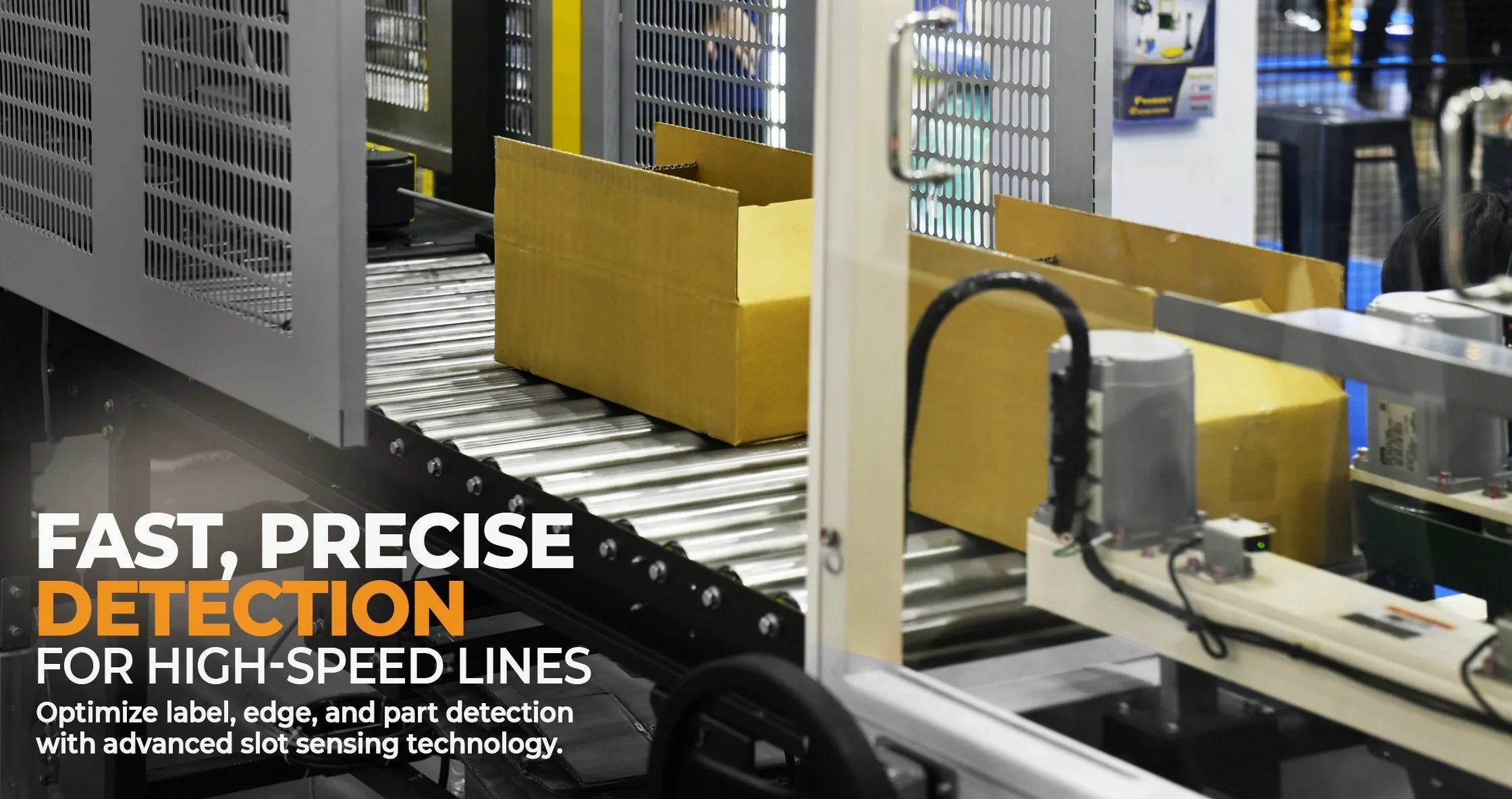
If you work in industrial automation, you know how important reliable object detection is on a line. The Banner SL30VB6VY slot sensor is a compact, U-shaped photoelectric device designed exactly for that purpose: fast, repeatable, through-beam detection inside a 30 mm slot. Because the emitter and receiver sit in a single thermoplastic housing, the Banner SL30VB6VY slot sensor eliminates the hassle of manually aligning two separate devices across a conveyor or guide. Instead, you simply mount the fork-shaped body where your label, web, or part will pass through and let the visible red beam do the work.
At its core, the Banner SL30VB6VY slot sensor is built around a visible 680 nm red LED that projects across the slot opening to a matching receiver. When an object interrupts the beam, one of the two built-in outputs (NPN or PNP) switches state. Because the Banner SL30VB6VY slot sensor is a fast-response model with a typical response time of 300 µs, it is well suited to high-speed operations such as gear tooth counting, edge guiding, and label registration where every millisecond matters.
Another key advantage of the Banner SL30VB6VY slot sensor is its simplicity in the field. With an integrated 4-turn sensitivity potentiometer, clearly marked LEDs, and a flexible gray wire that selects Light-ON or Dark-ON operation, technicians can tune the sensor in minutes. The housing includes two mounting holes, allowing installers to bolt the Banner SL30VB6VY slot sensor directly to fixtures or to a dedicated bracket without complex mechanical work.
What Is the Banner SL30VB6VY Slot Sensor?
The Banner SL30VB6VY slot sensor belongs to Banner’s SL series of opposed-mode slot sensors. In this design, the emitter and receiver are permanently aligned inside a U-shaped frame. Instead of installing an emitter on one side of a conveyor and a receiver on the other, you mount a single Banner SL30VB6VY slot sensor unit and pass the target object through the slot. This simplifies installation, reduces wiring, and minimizes the risk of misalignment caused by vibration or accidental bumps.
Electrically, the Banner SL30VB6VY slot sensor is powered from a 10–30 V DC supply, drawing up to about 30 mA. It provides two solid-state outputs: one NPN (sinking) and one PNP (sourcing), each rated to switch up to 150 mA. That means the Banner SL30VB6VY slot sensor can work in a wide range of PLC and controller environments, whether your I/O expects sourcing or sinking signals. Short-circuit and power-up fault protection add a layer of robustness to the outputs, an important consideration when the sensor is used in dense control cabinets or on busy machine frames.
Mechanically, the Banner SL30VB6VY slot sensor offers a 30 mm wide by 45 mm deep slot opening, with the beam positioned roughly 10 mm from the front edge of the fork. That geometry makes it ideal for monitoring narrow webs, labels, or edges while still giving enough depth to accommodate moving parts or slightly misfed materials. Because the Banner SL30VB6VY slot sensor uses a visible red beam, it is also very intuitive to set up: maintenance staff can see the approximate beam position, insert a test target, and watch the LEDs to confirm operation.
The sensor body is molded from an ABS/polycarbonate blend with acrylic windows over the optics. This rugged thermoplastic construction, combined with environmental ratings, allows the Banner SL30VB6VY slot sensor to withstand the dust, vibration, and occasional washdowns common in industrial spaces. Thanks to its integrated 2 m, 5-conductor PVC cable, the SL30VB6VY can be wired directly to junction boxes or I/O modules with minimal extra hardware.
Key Technical Specifications of the Banner SL30VB6VY Slot Sensor
When choosing a Banner SL30VB6VY slot sensor, it helps to understand the core technical specifications and how they translate into real-world performance. The operating voltage range is 10–30 V DC, with built-in protection against reverse polarity and transient spikes, making the Banner SL30VB6VY slot sensor compatible with standard 24 V systems and more robust industrial supplies.
One of the hallmark specs of the Banner SL30VB6VY slot sensor is its fast response time—typically around 300 µs. By contrast, the standard SL30VB6V version has a 1 ms response time. While 1 ms is perfectly adequate for many applications, the faster response of the Banner SL30VB6VY slot sensor shines in high-speed lines where labels, holes, or gear teeth move rapidly through the slot. Faster response contributes to higher positioning accuracy and more reliable count signals for a PLC or counter module.
The sensor’s repeatability is in the order of 75 µs, which gives consistent actuation points when the same target passes through the beam multiple times. For OEMs and machine builders, that level of repeatability makes the Banner SL30VB6VY slot sensor a solid choice in applications that demand precise registration—such as printing marks, perforation detection, and synchronous indexing.
On the output side, each of the two outputs of the Banner SL30VB6VY slot sensor (one NPN, one PNP) can switch up to 150 mA. They are solid-state outputs, meaning there are no mechanical contacts to wear out. This makes the Banner SL30VB6VY slot sensor well suited to frequent switching scenarios, like counting thousands of parts per shift or continuously monitoring web position. Short-circuit protection ensures that wiring errors or temporary faults are less likely to damage the sensor electronics.
The slot opening of the Banner SL30VB6VY slot sensor is 30 mm wide and approximately 45 mm deep. That combination balances clearance and sensitivity: the beam covers the 30 mm gap, while the 45 mm depth gives enough mechanical reach to accept parts or webs without crowding the housing. The visible red LED operating at around 680 nm not only simplifies alignment but also makes it easier to diagnose misfeeds or mechanical obstructions in front of the Banner SL30VB6VY slot sensor during maintenance.
Design, Construction, and Environmental Ratings
The physical construction of the Banner SL30VB6VY slot sensor is designed for durability in real-world manufacturing environments. The housing is an ABS/polycarbonate blend, chosen for impact resistance and dimensional stability, while the lens windows are acrylic for clear light transmission. Two mounting holes, sized around 5.6 mm, allow the Banner SL30VB6VY slot sensor to be directly bolted to panels, brackets, or machine frames using common hardware.
From an environmental perspective, the Banner SL30VB6VY slot sensor carries an IP67 and NEMA 6 rating. This means it is dust-tight and capable of withstanding temporary immersion in water when properly installed. In practice, IP67/NEMA 6 makes the Banner SL30VB6VY slot sensor suitable for many harsh settings, including areas that may experience washdowns, coolant splashes, or high humidity. The specified operating temperature range is approximately –40 °C to +70 °C with non-condensing humidity up to 90%, giving it a broad envelope for both cold storage and warm production spaces.
Internally, indicator LEDs provide at-a-glance status for the Banner SL30VB6VY slot sensor. A green LED lights when power is present, confirming that the device is energized. An amber LED indicates the output state—usually showing whether the beam is clear or blocked. These visual indicators are especially helpful during commissioning and troubleshooting. Seeing the amber LED change as a test target crosses the slot immediately confirms that the Banner SL30VB6VY slot sensor is detecting correctly and that the sensitivity is appropriately set.
The cable on the Banner SL30VB6VY slot sensor is a 2 m, 5-conductor PVC cable, permanently attached at the factory. This ensures a sealed, strain-relieved connection that maintains the IP67 rating. For installations requiring quick-disconnect connectors, other models in the same family offer M12 plug versions, but in the SL30VB6VY variant, the attached cable keeps things simple and robust. The clearly color-coded conductors (brown, blue, black, white, gray) make wiring the Banner SL30VB6VY slot sensor intuitive when following the printed wiring diagram on the housing.
Mounting and Wiring the Banner SL30VB6VY Slot Sensor
Installing a Banner SL30VB6VY slot sensor is generally straightforward, but paying attention to the details will pay off in long-term reliability. Mechanically, you can mount the sensor directly using its two 5.6 mm mounting holes or use a dedicated SMBSL bracket (or similar) to secure the Banner SL30VB6VY slot sensor at the correct angle. The U-shape should be oriented so that your target—label web, gear, small part—passes through the 30 mm gap along the beam path.
A molded arrow on the emitter arm indicates the direction of the light beam in the Banner SL30VB6VY slot sensor. During setup, you can move a sample target through the slot while watching the amber LED. As the object breaks the beam, the LED will change state. This visual feedback allows you to confirm that the Banner SL30VB6VY slot sensor is positioned correctly and that the beam is intersecting the object at the right height and orientation for your application.
For wiring, the Banner SL30VB6VY slot sensor uses a standard 5-wire color coding. The brown lead connects to +V (10–30 V DC), while the blue lead connects to 0 V (ground). The black and white leads provide the NPN and PNP outputs, respectively, allowing the Banner SL30VB6VY slot sensor to interface with a variety of PLC input modules. Finally, the gray lead is used to select Light-ON or Dark-ON operation. Connecting the gray wire to +V sets the Banner SL30VB6VY slot sensor to Dark-ON (output active when the beam is blocked), while connecting it to 0 V selects Light-ON mode (output active when the beam is clear).
Sensitivity adjustment is handled by a 4-turn potentiometer located on the housing. Banner recommends setting sensitivity for the Banner SL30VB6VY slot sensor midway between the thresholds for the light and dark states. In practice, you insert a representative target into the slot, observe the amber LED transition, and then fine-tune the potentiometer until the switching is stable and repeatable. This process ensures that the Banner SL30VB6VY slot sensor maintains reliable detection even when there are small variations in part color, surface finish, or ambient conditions.
From a protection standpoint, the datasheet advises using proper overcurrent protection for the outputs of the Banner SL30VB6VY slot sensor. This could mean fusing the supply or using a current-limited power source, depending on your control panel standards. Taking the time to incorporate this protection helps ensure that, if a wiring error occurs or an unexpected short develops, the Banner SL30VB6VY slot sensor will not be permanently damaged.
Typical Applications for the Banner SL30VB6VY Slot Sensor
One of the reasons engineers choose the Banner SL30VB6VY slot sensor is its versatility across a wide range of sensing tasks. Because the beam is confined within the 30 mm slot, it naturally lends itself to presence/absence detection of small parts, edges, or holes that pass through the gap. In label and web applications, the Banner SL30VB6VY slot sensor is often used to detect registration marks, gaps, or perforations that indicate where cutting, sealing, or printing should occur.
Hole detection is another classic use case for the Banner SL30VB6VY slot sensor. If a component has holes or slots, you can pass it through the sensor’s fork so the beam passes through the openings. When the beam is interrupted by solid material, the Banner SL30VB6VY slot sensor switches; when a hole aligns with the beam, it clears. This technique enables simple, robust confirmation of hole presence or verification that a part is oriented correctly before it proceeds to the next station.
The Banner SL30VB6VY slot sensor also excels in gear tooth and edge counting applications. As each tooth or edge passes through the beam, it interrupts the light, generating a pulse for the controller. Because the response time of the Banner SL30VB6VY slot sensor is only about 300 µs, it can keep up with high-speed rotational or linear motion where slower sensors might miss events. This makes it a good fit for conveyor synchronization, motor feedback, and simple speed monitoring schemes.
Edge guiding is another area where the Banner SL30VB6VY slot sensor finds use. By positioning the slot so that the edge of a moving web partially occludes the beam, you can detect lateral shifts in position. Small changes in the beam interruption pattern as the web moves side to side can be interpreted by control systems to keep material aligned. In combination with actuators, the Banner SL30VB6VY slot sensor helps maintain product quality by ensuring that printing, cutting, and sealing processes stay centered.
Beyond these specific tasks, the Banner SL30VB6VY slot sensor can serve in general object detection wherever a compact, self-contained break-beam sensor is desired. Any application that benefits from a 30 mm detection window and fast switching can consider the Banner SL30VB6VY slot sensor as a candidate, especially in packaging, printing, converting, and light assembly operations.
Alternative Models, Variants, and Accessories
While the Banner SL30VB6VY slot sensor is a powerful all-rounder, the broader SL family includes related models that may suit different needs. For example, the SL30VB6V version offers the same 30 mm slot and dual bipolar outputs but with a standard 1 ms response time instead of the faster 300 µs provided by the Banner SL30VB6VY slot sensor. If your line speed is moderate and cost is a concern, the standard version may be sufficient.
Connector variations are also available. The SL30VB6VQ, for instance, replaces the fixed cable with a 5-pin M12 Euro-style quick-disconnect connector. Likewise, the SL30VB6VYQ offers the same fast response as the Banner SL30VB6VY slot sensor but with a QD connector for rapid replacement or swap-out. If you prefer removable cordsets for maintenance, you might opt for a QD version instead of the fixed-cable Banner SL30VB6VY slot sensor.
Cable length variants round out the product line. By adding a suffix such as “W/30” to the model, you can specify a 9 m cable instead of the standard 2 m. For installations where the Banner SL30VB6VY slot sensor must reach a distant control cabinet or junction box, this extended cable option can simplify wiring and reduce the need for separate terminal boxes.
If your application demands a narrower slot, the SL10 series provides 10 mm slot sensors with similar features to the Banner SL30VB6VY slot sensor. Conversely, for more extreme environments or larger slots, the SLM series offers metal-housed rugged slot sensors, including models with 80 mm openings. Each of these families uses comparable opposed-mode sensing principles, so the choice often comes down to slot width, housing material, and whether you need the fast response of a product like the Banner SL30VB6VY slot sensor.
Accessories are an important part of the picture as well. For quick-disconnect models, Banner’s MQDC1 series cordsets (straight or right-angle, in various lengths) provide reliable connectivity. The SMBSL stainless-steel bracket is designed to mount SL/SLM sensors securely, allowing precise positioning of a Banner SL30VB6VY slot sensor relative to the product flow. Using the right accessories ensures that the mechanical and electrical setup of the Banner SL30VB6VY slot sensor supports long-term stable operation.
Compliance, Certifications, and Quality Assurance
In industrial environments, compliance and certifications play a key role in product selection. The Banner SL30VB6VY slot sensor carries common approvals, including CE marking and UL/cUL recognition for use in North America. For many OEMs and panel builders, this means the Banner SL30VB6VY slot sensor can be integrated into systems destined for the EU, US, or Canadian markets without additional sensor-level approvals.
Environmental regulations are equally important. The Banner SL30VB6VY slot sensor is RoHS-compliant and widely listed as containing no SVHC (Substances of Very High Concern) under European directives. From a practical standpoint, this ensures that the Banner SL30VB6VY slot sensor aligns with modern environmental and safety standards, reducing concerns about hazardous substances in your machine’s bill of materials.
Country of origin information—China, in this case—is often documented for sourcing and quality tracking. Combined with Banner’s long track record in industrial sensing, these certifications give buyers confidence that the Banner SL30VB6VY slot sensor meets both performance and regulatory expectations. When combined with proper installation practices, the Banner SL30VB6VY slot sensor provides a dependable foundation for critical detection tasks in manufacturing, packaging, and processing lines.
Best Practices for Getting Reliable Performance
To get the most out of a Banner SL30VB6VY slot sensor, it helps to follow a few best practices in design, installation, and maintenance. First, consider the mechanical alignment of the slot relative to your target. Ensure the Banner SL30VB6VY slot sensor is mounted so that the object consistently passes through the same region of the beam; avoid mounting where vibration or flexing of guides could shift the target out of the slot. Use rigid brackets and, where possible, mechanical stops to keep the Banner SL30VB6VY slot sensor fixed in place.
Next, take advantage of the sensitivity adjustment on the Banner SL30VB6VY slot sensor. Rather than leaving the potentiometer in a random position, run a short test with your actual product. Move the target through the slot multiple times and tweak the sensitivity until the amber LED switches reliably with a good margin between light and dark states. This ensures the Banner SL30VB6VY slot sensor remains stable despite slight changes in material color, dust buildup, or minor alignment shifts.
Electrical design also matters. Provide adequate overcurrent protection on the supply feeding the Banner SL30VB6VY slot sensor, and confirm that the outputs are wired within their 150 mA rating. If you are driving only PLC inputs, current draw is usually low, but it is still wise to respect the limits. Keep cable runs tidy, avoid routing the Banner SL30VB6VY slot sensor cable alongside high-noise sources like motor leads where possible, and ensure a solid 0 V reference to minimize signal issues.
Routine maintenance is relatively simple. Periodically inspect the lens windows of the Banner SL30VB6VY slot sensor for dust, oil, or debris, and gently clean them with a soft cloth if necessary. Check the mounting screws or bracket fasteners to verify that vibration has not loosened the Banner SL30VB6VY slot sensor over time. A quick functional test—moving a test target through the slot and observing the LED response—can confirm that everything is operating as intended.
Related Product Collections
If you are exploring how to integrate a Banner SL30VB6VY slot sensor into a wider automation setup, these curated collections are a great next step:
- Sensors Collection ➜ – Browse a broad range of industrial sensors, from proximity and limit switches to advanced photoelectric sensors, so you can build a complete detection strategy around the Banner SL30VB6VY slot sensor.
- Photoelectric Sensors Collection ➜ – Dive into dedicated photoelectric sensing options, including through-beam, retro-reflective, and background suppression models that complement the Banner SL30VB6VY slot sensor for more complex applications.
- Banner Products Collection ➜ – Explore other Banner-brand solutions—photoelectric, ultrasonic, and more—that pair naturally with the Banner SL30VB6VY slot sensor when you want a cohesive, brand-consistent sensing platform.
Conclusion: Is the Banner SL30VB6VY Slot Sensor Right for You?
For many machine builders, maintenance technicians, and automation engineers, the Banner SL30VB6VY slot sensor strikes a practical balance between performance, ruggedness, and ease of use. Its fast 300 µs response time, dual NPN/PNP outputs, and 30 mm slot opening make the Banner SL30VB6VY slot sensor a strong candidate for high-speed label detection, hole verification, gear counting, and edge guiding. At the same time, the visible red beam, onboard LEDs, and adjustable sensitivity help simplify daily setup and troubleshooting.
If your application demands reliable break-beam detection in a compact U-shaped housing—and you need a sensor that is fully at home in industrial environments—then it is worth taking a closer look at the Banner SL30VB6VY slot sensor. Reviewing the detailed specifications, variants, and accessories on the product page will help you confirm the best model for your line, cable length, and mounting approach. When you are ready to explore options, compare alternatives, or integrate the Banner SL30VB6VY slot sensor into your next project, simply head over to the dedicated product page to see full specs, availability, and documentation tailored to your needs.
