
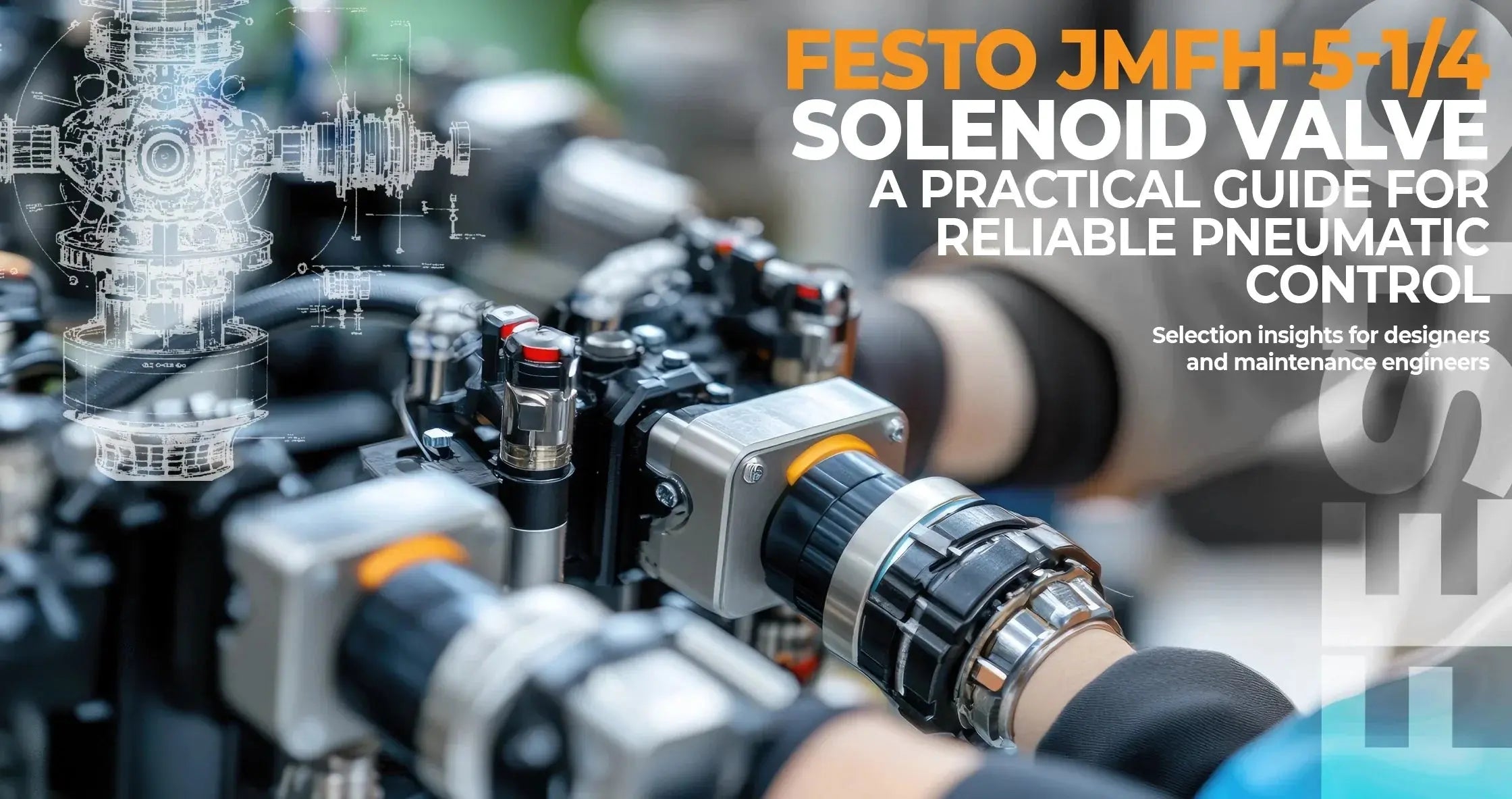
When you are designing or maintaining a pneumatic system, you need components you can trust to switch quickly, run reliably, and stay easy to service. That is exactly where the Festo JMFH-5-1/4 solenoid valve, paired with the MSFG-24/42-50/60 24 V DC coil, earns its place in so many machines and panels around the world. In this guide, we will unpack what this valve and coil combination can really do for your application, so you can decide confidently if the Festo JMFH-5-1/4 solenoid valve is the right fit for your next project.
Rather than just copying a datasheet, this article walks through the real engineering implications behind the numbers. You will see how flow rate, switching time, air quality, mounting options, and electrical details all connect back to performance and uptime. By the end of this guide, you will know exactly where the Festo JMFH-5-1/4 solenoid valve shines, what to watch out for, and how to choose alternatives from the same family when your requirements change.
What is the Festo JMFH-5-1/4 solenoid valve
At its core, the Festo JMFH-5-1/4 solenoid valve is a 5 port, 2 position bistable directional control valve designed for G 1/4 pneumatic circuits. In plain language, this means the valve has ports for supply, two cylinder lines, and two exhaust lines, and it switches between two stable positions using double solenoids. Because the Festo JMFH-5-1/4 solenoid valve is bistable, it stays in its last commanded position even after the electrical signal is removed, which is ideal for many pulse controlled or energy conscious systems.
The design is based on a piloted poppet seat structure, which combines good sealing with robust switching performance. Festo couples this mechanical core with the MSFG-24/42-50/60 coil family, giving the Festo JMFH-5-1/4 solenoid valve a flexible electrical interface and broad voltage options. With an orifice nominal size of 7 millimetres and a standard nominal flow rate of about 1100 litres per minute according to DIN 1343, this valve comfortably covers a wide range of small and medium double acting cylinder applications in general industrial automation.
Why the Festo JMFH-5-1/4 solenoid valve is still a workhorse
In many plants you will find legacy and new machines running side by side, and the Festo JMFH-5-1/4 solenoid valve continues to be specified because it balances flow, footprint, and reliability. Its construction width of about 30.5 millimetres and a grid dimension of 32 millimetres makes it easy to mount on standard manifolds and panels, while still allowing the Festo JMFH-5-1/4 solenoid valve to handle real world flow demands without becoming a bottleneck.
The valve’s bistable behaviour is also a big part of its appeal. With a double solenoid arrangement, the Festo JMFH-5-1/4 solenoid valve only requires a momentary signal to change state, then mechanically holds that position until the opposite coil is energised. For machine builders, this can reduce continuous power consumption on outputs, simplify safety considerations, and provide a useful level of position memory if supply power is lost. In applications where the actuator must remain in its last position after a power drop, the Festo JMFH-5-1/4 solenoid valve is a practical and proven option.
Key technical specifications of the Festo JMFH-5-1/4 solenoid valve
From a design perspective, one of the first numbers you will check is the flow rating. The Festo JMFH-5-1/4 solenoid valve delivers a standard nominal flow rate around 1100 litres per minute at its working ports, thanks to a nominal orifice of 7 millimetres. This makes the Festo JMFH-5-1/4 solenoid valve suitable for a wide range of cylinder sizes in packaging, handling, and light process automation, provided you verify actual flow against your pressure and piping layout.
Ports 1, 2, 4, 3, and 5 on the Festo JMFH-5-1/4 solenoid valve are all G 1/4 threaded, while the pilot exhaust ports 82 and 84 use M5 threads. The flow direction is fixed and non reversible, so you must observe the correct port assignment when plumbing the system. The operating pressure range for the Festo JMFH-5-1/4 solenoid valve typically covers from about 1.5 bar up to 8 bar, which is sufficient for most plant compressed air systems that run between 5 and 7 bar.
Operating conditions for the Festo JMFH-5-1/4 solenoid valve
Like any pneumatic component, the operating medium and environmental conditions are critical. The Festo JMFH-5-1/4 solenoid valve is designed for compressed air according to ISO 8573-1 compressed air quality class around 7 4 4. In practice, that means you need filtration good enough to remove harmful particulates and moisture to protect the internals of the Festo JMFH-5-1/4 solenoid valve. Lubricated operation is allowed, but once you introduce oil, you must keep the system lubricated for the life of the valve to avoid seal damage from intermittent lubrication.
Temperature limits for the Festo JMFH-5-1/4 solenoid valve generally sit between minus 10 and plus 60 degrees Celsius for the medium, with ambient conditions typically from about minus 5 to plus 40 degrees Celsius, assuming a dry industrial environment. These ranges cover most indoor factory settings, but if you are working in harsh environments, outdoor installations, or extreme temperatures, you should double check whether the Festo JMFH-5-1/4 solenoid valve is the right choice or if a higher protection variant is required.
Construction, materials, and corrosion behaviour
Mechanically, the Festo JMFH-5-1/4 solenoid valve uses a die cast aluminium housing with seals made from NBR and polyurethane based materials. This combination gives the Festo JMFH-5-1/4 solenoid valve a good balance of strength, weight, and sealing performance for standard industrial environments. The valve sits in corrosion resistance class CRC 1, which indicates suitability for low corrosion stress conditions, such as dry indoor machines and control cabinets.
If your machine operates in areas with aggressive cleaning agents, heavy humidity, or outdoor exposure, you may need to consider higher CRC valves or stainless alternatives. However, for the vast majority of packaging lines, material handling systems, and general industrial equipment, the corrosion performance of the Festo JMFH-5-1/4 solenoid valve is more than adequate, especially when installed away from direct washdown zones.
Inside the MSFG-24/42-50/60 coil that drives the Festo JMFH-5-1/4 solenoid valve
The electrical side of the assembly is handled by the MSFG-24/42-50/60 coil, which is designed to work seamlessly with the Festo JMFH-5-1/4 solenoid valve. In the 24 volt direct current version, this coil typically draws around 4.5 watts and is rated for continuous duty at 100 percent duty cycle. That means you can safely energise the coil for extended periods without overheating, even though the bistable nature of the Festo JMFH-5-1/4 solenoid valve often allows you to operate with short pulses instead of constant power.
The coil is built for flexibility with optional AC ratings such as 42 volt at 50 or 60 hertz, with typical pick up and holding power ratings defined in the datasheet. It mounts onto the armature tube of the Festo JMFH-5-1/4 solenoid valve via a knurled nut, and the electrical connection is made using a three pin Festo style plug such as the MSSD F. The coil and plug combination provides IP65 protection when assembled correctly, giving the Festo JMFH-5-1/4 solenoid valve a robust barrier against dust and water jets from any direction.
Electrical characteristics and diagnostics with the Festo JMFH-5-1/4 solenoid valve
Modern PLC output modules often use short test pulses for line diagnostics, and not every valve coil handles these pulses gracefully. The MSFG coil used with the Festo JMFH-5-1/4 solenoid valve is designed to tolerate a defined range of positive and negative test pulses without causing unwanted switching. For designers, this means you can integrate the Festo JMFH-5-1/4 solenoid valve into safety rated or diagnostic heavy control systems with greater confidence that nuisance actuation will not be an issue.
The rated voltage tolerance and permissible frequency variation are also generous, allowing the Festo JMFH-5-1/4 solenoid valve with MSFG coil to operate reliably even when supply conditions are not perfectly stable. Combined with optional accessories like plugs with LED indication or surge suppression inserts, you can further improve troubleshooting and protect the Festo JMFH-5-1/4 solenoid valve coils against voltage spikes in electrically noisy environments.
Flow, performance, and response time in real applications
On paper, the 1100 litre per minute flow rating of the Festo JMFH-5-1/4 solenoid valve looks impressive, but the real question is what it means in your machine. With its 7 millimetre orifice and G 1/4 ports, the Festo JMFH-5-1/4 solenoid valve is well suited for double acting cylinders in the small to medium range, such as those used on pick and place units, grippers, stoppers, and many packaging actuators.
The valve’s switching behaviour is another important factor. The Festo JMFH-5-1/4 solenoid valve offers a maximum switching frequency around 25 hertz and a reversal switching time of about 11 milliseconds under typical conditions. That fast response, combined with an underlap characteristic that avoids deadband, lets the Festo JMFH-5-1/4 solenoid valve support precise timing and repeatability in high speed indexing or sequencing applications where each millisecond counts.
Exhaust control and speed adjustment with the Festo JMFH-5-1/4 solenoid valve
The exhaust air function of the Festo JMFH-5-1/4 solenoid valve can be configured with flow control on the exhaust ports. By throttling the exhaust at ports 3 and 5, you can adjust cylinder speeds directly in the pneumatic circuit, instead of relying only on upstream pressure regulation. This gives the Festo JMFH-5-1/4 solenoid valve an extra degree of flexibility, especially when tuning motion profiles to balance speed, impact, and vibration.
In practice, you will often combine the Festo JMFH-5-1/4 solenoid valve with external flow control valves on the cylinder ports, or silencers on the exhaust ports to reduce noise. The valve’s compatibility with standard accessories means you can easily integrate these components while maintaining reliable operation. Properly tuned, the Festo JMFH-5-1/4 solenoid valve becomes a central part of a smooth and precise pneumatic motion system that supports both production speed and operator comfort.
Installation and mounting best practices for the Festo JMFH-5-1/4 solenoid valve
Mechanical mounting options are straightforward and flexible. You can install the Festo JMFH-5-1/4 solenoid valve using through holes in the housing onto a subplate or machine structure, or mount it onto manifold rails such as the PAL or PRS series to build multi valve stations. Orientation is largely unrestricted, so the Festo JMFH-5-1/4 solenoid valve can be mounted horizontally, vertically, or at an angle, provided you respect general installation guidelines for access and drainage.
When assembling the coil onto the armature tube, you tighten the knurled nut to the torque specified by Festo, which is typically around 150 newton centimetres. Then you attach the plug and set the cable gland torque according to the coil datasheet, often around 0.4 newton metres. Following these steps ensures the Festo JMFH-5-1/4 solenoid valve maintains its IP65 degree of protection and helps to avoid premature failures caused by loose connections or moisture ingress.
Piping and commissioning tips with the Festo JMFH-5-1/4 solenoid valve
During installation, always confirm the port labelling on the Festo JMFH-5-1/4 solenoid valve. Port 1 is the supply, ports 2 and 4 go to the cylinder, ports 3 and 5 are exhausts, and ports 82 and 84 handle pilot exhaust. Mis wiring or mis plumbing can lead to confusing symptoms, so taking a few seconds to double check the Festo JMFH-5-1/4 solenoid valve connections can save a lot of troubleshooting later.
Once plumbing is complete, verify that your supply air pressure is within the allowed operating range and that the air quality meets the filtration and drying requirements. During commissioning, use the built in manual override on the Festo JMFH-5-1/4 solenoid valve to test actuation and cylinder movement without energising the coils. This makes it easy to confirm that the valve is plumbed correctly and that the actuator behaves as expected before you hand full control to the PLC.
Compliance and certifications for the Festo JMFH-5-1/4 solenoid valve
In many projects, compliance is not just a nice to have; it is a requirement. The Festo JMFH-5-1/4 solenoid valve, together with its MSFG coil, is typically recognised under cULus for use in North American markets when installed according to relevant standards. The materials used in the Festo JMFH-5-1/4 solenoid valve are RoHS compliant, which supports global export into regions that restrict hazardous substances.
The valve and coil combination can also comply with paint wetting impairment standards such as VDMA 24364, with the valve rated under B1 or B2 classes and the coil under C1. For machine builders working with painting or coating systems, this makes the Festo JMFH-5-1/4 solenoid valve a safe choice when it needs to be installed in or near PWIS sensitive zones. For explosion hazardous areas, you would step up to EX marked variants, which we will touch on later in this guide.
Typical applications for the Festo JMFH-5-1/4 solenoid valve
The flow rate, port size, and bistable function of the Festo JMFH-5-1/4 solenoid valve make it a natural fit for directional control of double acting cylinders. You will often find the Festo JMFH-5-1/4 solenoid valve in packaging machines, where cylinders operate gates, pushers, clamps, and formers along a line. Its robust construction and fast switching give consistent performance shift after shift.
Another common arena is material handling and conveying. Here the Festo JMFH-5-1/4 solenoid valve may drive stoppers, diverters, and lift mechanisms that route products between lanes or levels. Because the Festo JMFH-5-1/4 solenoid valve holds its position without continuous coil power, designers can optimise output usage, reduce thermal load on control panels, and maintain actuator position if power is briefly lost.
Pulse controlled systems and energy efficiency
One of the underrated strengths of the Festo JMFH-5-1/4 solenoid valve is how well it fits pulse controlled systems. A PLC output can deliver a short pulse to one coil to move the valve, and a pulse to the opposite coil to return it. This means the Festo JMFH-5-1/4 solenoid valve does not require continuous energisation in either state, which can significantly reduce average power consumption on machines with many valves.
In large panels with dozens of valves, this can help limit the heat load on components and reduce the required size or complexity of ventilation. Over the lifetime of a machine, the energy savings from using a bistable design like the Festo JMFH-5-1/4 solenoid valve may be modest per valve but meaningful when multiplied across an entire production line, especially in regions where energy costs are high.
Variants and alternatives to the Festo JMFH-5-1/4 solenoid valve
Even when you like the base design, you sometimes need variations to match local standards or special conditions. Within the same family, Festo offers a number of alternatives that build on the core strengths of the Festo JMFH-5-1/4 solenoid valve. For example, the JMFH-5-1/4-NPT variant keeps the same flow and function but uses NPT 1/4 threads instead of G 1/4, making it ideal for markets where NPT is the dominant standard.
For higher flow demands, you might consider the JMFH-5-1/4-B version. This alternative increases the nominal orifice to around 10 millimetres and boosts the flow rate to around 1600 litres per minute, while still using G 1/4 ports. The operating pressure range also extends up to about 10 bar. This means the JMFH-5-1/4-B keeps a similar footprint to the Festo JMFH-5-1/4 solenoid valve but offers more headroom when you are driving larger cylinders or faster stroke cycles.
External piloting and ATEX options based on the Festo JMFH-5-1/4 solenoid valve
In applications where main line pressure is very low, or where you are switching vacuum, you might need an externally piloted version. Festo addresses this with the JMFH-5-1/4-S, which allows a separate pilot air supply to drive the valve. This variant keeps the same basic function as the Festo JMFH-5-1/4 solenoid valve but breaks the dependency on main line pressure for actuation.
For explosion hazardous atmospheres, ATEX rated versions such as the JMFH-5-1/4-S-EX or JMFH-5-1/4-B-EX are available. These models deliver similar flow and porting but are certified under relevant explosion protection directives. They are not simply drop in replacements for the standard Festo JMFH-5-1/4 solenoid valve, as they come with specific mounting, wiring, and operational requirements, but they provide a clear path when your application must meet stringent safety codes.
Monostable MFH vs the Festo JMFH-5-1/4 solenoid valve
Sometimes you want a fail safe default position rather than a bistable design. In that case, the MFH-5-1/4 monostable valve is often considered alongside the Festo JMFH-5-1/4 solenoid valve. The MFH model uses a single solenoid with a spring return that drives the valve back to a defined rest state when power is removed.
From a design perspective, choosing between the MFH and the Festo JMFH-5-1/4 solenoid valve comes down to what you want the actuator to do on power loss. If you want the actuator to return to a safe home position, monostable MFH may be better. If you want the actuator to hold its last state until specifically commanded otherwise, the bistable Festo JMFH-5-1/4 solenoid valve is the more suitable choice.
Compatible accessories that enhance the Festo JMFH-5-1/4 solenoid valve
The valve really comes into its own when paired with the right accessories. Festo offers coil variants in the MSFG and MSFW ranges for different voltages, so you can match the Festo JMFH-5-1/4 solenoid valve to 12 V, 24 V, 110 V, or 230 V supplies depending on your control architecture. Plug options include standard connectors, plugs with LED indication, and plugs with integrated surge suppression or pre moulded cable for faster panel wiring.
On the pneumatic side, manifolds like the PAL and PRS series allow you to mount multiple Festo JMFH-5-1/4 solenoid valves on a common supply and exhaust rail, simplifying air distribution. Mufflers on the exhaust ports reduce noise and oil mist, while flow control valves at the cylinder ports fine tune speed. When service is required after long use, wear part kits provide seals and internal components specifically matched to the Festo JMFH-5-1/4 solenoid valve, helping to extend its life without full replacement.
Maintenance and troubleshooting tips for the Festo JMFH-5-1/4 solenoid valve
A well installed Festo JMFH-5-1/4 solenoid valve can run for years with minimal attention, but a few simple practices will stretch its life even further. First, keep the compressed air quality in line with the recommended ISO class. Dirty or wet air is one of the fastest ways to shorten the life of the Festo JMFH-5-1/4 solenoid valve, causing sticking, premature seal wear, or corrosion.
Second, avoid changing from lubricated to unlubricated air without a good reason. If your system starts out lubricated, treat it as permanently lubricated so that the seals in the Festo JMFH-5-1/4 solenoid valve live in a consistent environment. Finally, check periodically that coil nuts, plugs, and cable glands remain tight, and that there are no signs of overheating or damage on the MSFG coil or the body of the Festo JMFH-5-1/4 solenoid valve.
Diagnosing common symptoms on the Festo JMFH-5-1/4 solenoid valve
If an actuator stops moving or behaves erratically, the valve is often suspected first. When diagnosing issues with a Festo JMFH-5-1/4 solenoid valve, start by using the manual overrides to see whether the valve can switch positions mechanically. If the valve works with manual override but not electrically, the problem is likely in the coil, plug, wiring, or PLC output, not the mechanical core of the Festo JMFH-5-1/4 solenoid valve.
If the valve does not switch even with manual override, look for issues like blocked exhaust ports, insufficient supply pressure, or contamination inside the valve. In such cases, cleaning, replacing silencers, or installing a wear parts kit may restore the Festo JMFH-5-1/4 solenoid valve to normal operation. If your plant air quality is poor, investing in better filtration upstream will protect this and other valves from recurring failures.
When to upgrade or replace the Festo JMFH-5-1/4 solenoid valve
Over time, every mechanical component reaches a point where repair is no longer the best option. For the Festo JMFH-5-1/4 solenoid valve, telltale signs include recurring sticking after cleaning, visible wear on critical components, or leaks that persist even after installing a wear parts kit. In those cases, replacing the Festo JMFH-5-1/4 solenoid valve entirely may be more cost effective than continued troubleshooting.
When you replace older valves, you can also take the opportunity to standardise on the latest coil versions, add LED or surge protected plugs, and reorganise your manifolds or piping for better access. This keeps the Festo JMFH-5-1/4 solenoid valve ready for the next phase of your machine’s life and makes future maintenance easier for technicians.
Related product collections for your pneumatic system
If you are reviewing the Festo JMFH-5-1/4 solenoid valve for a project, you will often need complementary components and alternatives for other parts of your system. Here are three related collections from Industrial Electrical Warehouse that can help you round out your design or maintenance list:
-
Festo – Valves, Pneumatics & Industrial Components ➜
Explore a wide range of Festo products including valves, cylinders, regulators, and fittings so you can standardise your pneumatic system around a trusted brand. -
Hydraulic Cylinders, Pneumatics, Valves & Pumps ➜
Browse a broader mix of hydraulic and pneumatic components, including solenoid valves, pumps, and actuators, ideal for building or upgrading complete fluid power systems. -
Pneumatic Cylinders, Solenoid Valves, Hydraulic Cylinders, Manifolds ➜
Focus on pneumatic cylinders, manifolds, and solenoid valves that pair well with the Festo JMFH-5-1/4 solenoid valve in packaging, handling, and general automation applications.
Conclusion: putting the Festo JMFH-5-1/4 solenoid valve to work in your system
By now, you have seen how much engineering thought is packed into the Festo JMFH-5-1/4 solenoid valve and its MSFG-24/42-50/60 coil. From its 5 port, 2 position bistable design and strong 1100 litre per minute flow, to its rugged aluminium body and IP65 coil protection, the Festo JMFH-5-1/4 solenoid valve offers a dependable foundation for many pneumatic control tasks. With variants for higher flow, external piloting, different port standards, and even ATEX use, it also gives you a clear upgrade path when your requirements evolve.
If you are specifying hardware for a new machine or planning an upgrade during the next shutdown, it is worth taking a closer look at how the Festo JMFH-5-1/4 solenoid valve aligns with your cylinders, air quality, and control strategy. Reviewing the full product page, including accessories, coil options, and wear part kits, will help you confirm the right configuration and simplify future maintenance. When you are ready, visit the product page for the Festo JMFH-5-1/4 solenoid valve to explore detailed specifications, compatible components, and availability for your next project.
